
Is Winstler Safe for UK Players? Licence, UKGC Status and Player Protection
 Available in GB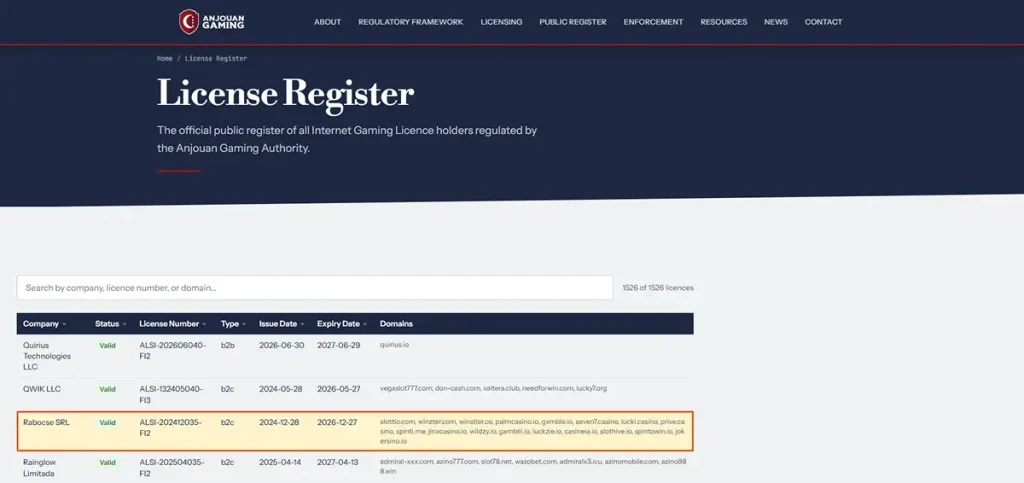
Winstler’s current operator is Rabocse SRL, and the current licence record ties the winstler.co domain to Anjouan licence ALSI-202412035-FI2. No verified UKGC licence was found for Winstler or Rabocse SRL. That distinction is the most important regulatory fact for a reader in England, Scotland or Wales: the Gambling Commission states that businesses providing remote gambling to consumers in Great Britain need a Commission licence even if the business is based abroad.
This does not justify the oversimplified labels “fully legal in the UK” or “illegal in the UK” across every part of the United Kingdom. Great Britain and Northern Ireland have different legal frameworks. It also does not prove that every Winstler feature is unsafe or false. Licensing is one isolated fact category. Bonus, game and payment claims need their own evidence. What the absence of a verified UKGC licence does change is the regulatory protection you should assume when using the site.
Table of Contents
- Winstler’s current operator and Anjouan licence
- Why the UKGC point matters in Great Britain
- GAMSTOP coverage should not be assumed for Winstler
- Great Britain and Northern Ireland are not the same gambling-law market
- What the missing UKGC licence does and does not tell you
- UKGC online-slot rules are not evidence about Winstler’s own limits
- How to verify a casino’s Great Britain licence yourself
- How this licensing position should affect an account decision
- Why a register check is stronger than a casino footer badge
- What to compare if local protection matters to you
- Regulatory questions worth answering before you deposit
- What Winstler’s Anjouan licence means for a player in Great Britain
Winstler’s current operator and Anjouan licence
The current operator identity is Rabocse Sociedad de Responsabilidad Limitada, usually shortened to Rabocse SRL. The current non-UK licence is recorded as Anjouan licence ALSI-202412035-FI2. This should not be confused with older Winstler material that refers to a previous operator cycle or other licensing claims. For current account and regulatory analysis, the current operator and current licence record take priority over historical branding.
An Anjouan licence and a UK Gambling Commission licence are different permissions issued under different legal systems. Holding an offshore licence does not turn into UKGC authorisation merely because a site can be viewed by someone in Britain. Equally, the lack of a UKGC licence does not erase the existence of the Anjouan licence. Those two facts should be kept separate rather than treating one as proof that the other exists.
| Question | Current verified position | What not to infer |
|---|---|---|
| Who operates Winstler? | Rabocse SRL in the current operator cycle | Do not rely on an older operator name for current account matters |
| What non-UK licence is recorded? | Anjouan licence ALSI-202412035-FI2 | Do not describe it as a UKGC licence |
| Is a UKGC licence verified? | No UKGC licence hit was verified for Winstler | Do not imply UKGC consumer protection or UK ADR coverage |
Why the UKGC point matters in Great Britain
The Gambling Commission’s current remote-casino guidance says that, regardless of where a business is based, it needs a Commission licence if it provides remote gambling facilities to consumers in Great Britain. The Commission also explains Great Britain as England, Scotland and Wales in its remote-sector guidance. This is a point-of-consumption model: an overseas corporate address does not remove the licence requirement when the operator is serving consumers in that market.
The UKGC Public Register is therefore the correct source for a claim that a remote casino is licensed in Great Britain. A marketing page, affiliate review or offshore certificate cannot substitute for a register hit. In Winstler’s case, no UKGC licence was verified, so Winstler should not be described as UKGC licensed, regulated by the Gambling Commission, or covered by protections that depend on that licence.
This regulatory point is different from operational availability. A site may be technically accessible, may present a registration flow and may have payment options without holding the local licence required for the Great Britain regulated market. Accessibility and authorisation answer different questions and should not be merged.
GAMSTOP coverage should not be assumed for Winstler
GAMSTOP states that all online gambling companies licensed in Great Britain must participate in its national online self-exclusion service. Its current terms also make clear that the service can only help block gambling services offered by participating operators. Because no UKGC licence was verified for Winstler, GAMSTOP participation or blocking should not be assumed.
That does not diminish the value of GAMSTOP for the licensed Great Britain market. It simply defines the boundary of the scheme. If self-exclusion is important to you, verify whether a site is licensed and participating before assuming that a national exclusion will apply. Do not test a self-exclusion by depositing or gambling. Use the operator list or Gambling Commission register instead.
Great Britain and Northern Ireland are not the same gambling-law market
The United Kingdom includes different gambling-law frameworks, while UKGC remote licensing is specifically a Great Britain framework. Great Britain covers England, Scotland and Wales. Northern Ireland has a separate gambling-law framework centred on the Betting, Gaming, Lotteries and Amusements (Northern Ireland) Order 1985, as amended in 2022. For that reason, a single sentence saying a casino is simply “legal in the UK” can be too imprecise to be useful.
For readers in England, Scotland or Wales, the most relevant local-authorisation question is whether the operator appears on the UKGC register for the remote activity being offered. For Northern Ireland, the legal framework and enforcement context differ. A Great Britain licensing rule should not be extended to Northern Ireland without qualification, and individual legal questions may require professional advice.
What the missing UKGC licence does and does not tell you
A missing local licence is highly relevant to regulatory protection, but it should not be used as a shortcut for every other conclusion. It does not by itself prove a bonus percentage is wrong, a listed payment method is unavailable, a particular game is fake, or a mobile site does not work. Those are separate facts and require separate evidence.
What the licence finding does tell you is narrower and more important: you should not assume Winstler is regulated by the Gambling Commission for Great Britain, should not assume UKGC complaint or enforcement protections apply to your Winstler account, and should not assume participation in Great Britain’s licensed-market tools such as GAMSTOP. If local regulatory protection is a major part of your casino decision, that difference should carry substantial weight.
For the evidence around complaints, third-party ratings and player disputes, use the dedicated Winstler complaints and reputation page. Keeping complaints on a separate child page prevents allegations or player reports from being presented as if they were licence-register facts.
UKGC online-slot rules are not evidence about Winstler’s own limits
Great Britain’s regulated online-slot market has maximum stake limits for UKGC-licensed operators. The Great Britain rules set a £5 maximum per game cycle for adults aged 25 and over and a £2 maximum for adults aged 18 to 24, with the younger-adult limit effective from 21 May 2025. These are rules for the UKGC-licensed Great Britain market.
They should not be copied onto Winstler as if they prove the settings of an offshore site. Those limits illustrate a consumer-facing control in the local licensed framework; they should not be treated as Winstler stake caps. If you want to know a game’s actual stake range on Winstler, that needs to be checked in the real game interface rather than inferred from UK regulation.
How to verify a casino’s Great Britain licence yourself
- Open the Gambling Commission Public Register from the Commission’s own website.
- Search the business name and any verified operator company name, not just the casino brand.
- Open the licence record and confirm the remote activity is active and relevant to the product being offered.
- Check the domain and trading names associated with the licence where the register provides them.
- Do not accept a footer logo or an offshore certificate as a substitute for a UKGC register entry.
The Commission states that its register includes licensed businesses, activities, domain and trading names supplied to it, and regulatory action. That makes the register a stronger source for Great Britain licensing than a general review page. If a licence claim matters to your decision, verify it there close to the time you play because corporate structures and licence statuses can change.
How this licensing position should affect an account decision
If you prefer operators within the Great Britain regulated market, the absence of a verified UKGC licence is a clear reason to compare Winstler with a UKGC-licensed alternative before depositing. That is not a prediction about whether any individual session will end well or badly. It is a comparison of regulatory recourse, self-exclusion coverage and the local licensing framework that sits behind the account.
If you are still researching Winstler, keep three tracks separate. First, confirm the licence and operator. Second, inspect the current terms that govern the specific product you want to use. Third, review payment and complaint evidence without treating either as a substitute for licensing. The Winstler withdrawals page covers payout-specific uncertainty, while Winstler registration and KYC explains identity checks without assuming a fixed document list.
Also remember that the Anjouan licence is a real licensing statement about the current operator cycle, not a UK authorisation. The correct wording is not “unlicensed” in a universal sense. It is that Winstler is tied to an Anjouan licence, while no UKGC licence was verified for Great Britain.
Why a register check is stronger than a casino footer badge
A licence logo in a footer is useful only when it can be traced to a regulator record that identifies the operator, the relevant activity and the current status. Logos can remain on cached pages, old reviews and saved images after an operator changes company or licence. A live register is better evidence because it is maintained by the regulator and is designed to show who is authorised, for what activity and under which identity.
For a Great Britain licence, the Gambling Commission register is the decisive local source. The Commission says licensed remote operators must display their licensed status and link customers to the Commission’s record. If a casino claims Great Britain regulation but you cannot connect the brand or operator to that public record, the claim should not be treated as verified merely because a UK flag, pound symbol or responsible-gambling logo appears on the site.
The same principle applies to offshore licensing. A current Anjouan record can establish that the operator holds that offshore permission, but it cannot establish a UKGC licence. Different regulators answer different jurisdiction questions. Keeping those records separate prevents a common review error in which an offshore licence is described as if it grants local British authorisation.
What to compare if local protection matters to you
Licence status becomes more useful when translated into practical comparison points. A reader choosing between Winstler and a Great Britain licensed casino can compare whether the operator appears on the UKGC register, whether GAMSTOP participation follows from that licence, whether the site’s licensed-status link resolves to a current Commission record, and which complaint or dispute routes are available under the applicable framework.
This comparison should happen before depositing, not after a dispute starts. Regulatory recourse is difficult to retrofit onto an account that was opened under a different jurisdiction. If your priority is access to Great Britain’s licensed-market protections, select an operator whose UKGC status can be verified directly. If you choose to examine an offshore operator instead, do so with the understanding that the regulator, rules and available escalation routes are different.
None of this guarantees the outcome of an individual gambling session or complaint. Regulation is a framework for operator obligations and oversight, not a promise that every customer experience will be problem-free. The useful conclusion is narrower: verified local licensing changes which rules and protections you can reasonably expect to apply.
Regulatory questions worth answering before you deposit
- Which legal entity currently operates the site?
- Which regulator issued the licence being displayed?
- Does the UKGC Public Register show the operator or brand for remote gambling in Great Britain?
- Does the site’s licensed-status statement link back to the regulator record?
- Which self-exclusion and dispute routes actually apply to that licence?
- Are you relying on a current register entry or an affiliate page repeating an old licence claim?
These questions matter because licence histories can become muddled when a brand changes operator or jurisdiction. A current register record and a current operator identity are more useful than a long list of historical badges.
What Winstler’s Anjouan licence means for a player in Great Britain
For a player in England, Scotland or Wales, Winstler’s Anjouan licence means the site has an identified offshore licensing jurisdiction, but it is not a substitute for a verified Gambling Commission licence. The Gambling Commission says remote operators serving Great Britain need its licence, and no UKGC licence has been verified for Winstler or Rabocse SRL. As a result, UKGC regulation, Great Britain licensed-market protections and GAMSTOP participation should not be attributed to Winstler. If those protections are important to you, treat the licensing difference as a core decision factor rather than a footnote. For the broader product picture, return to the full Winstler UK review.